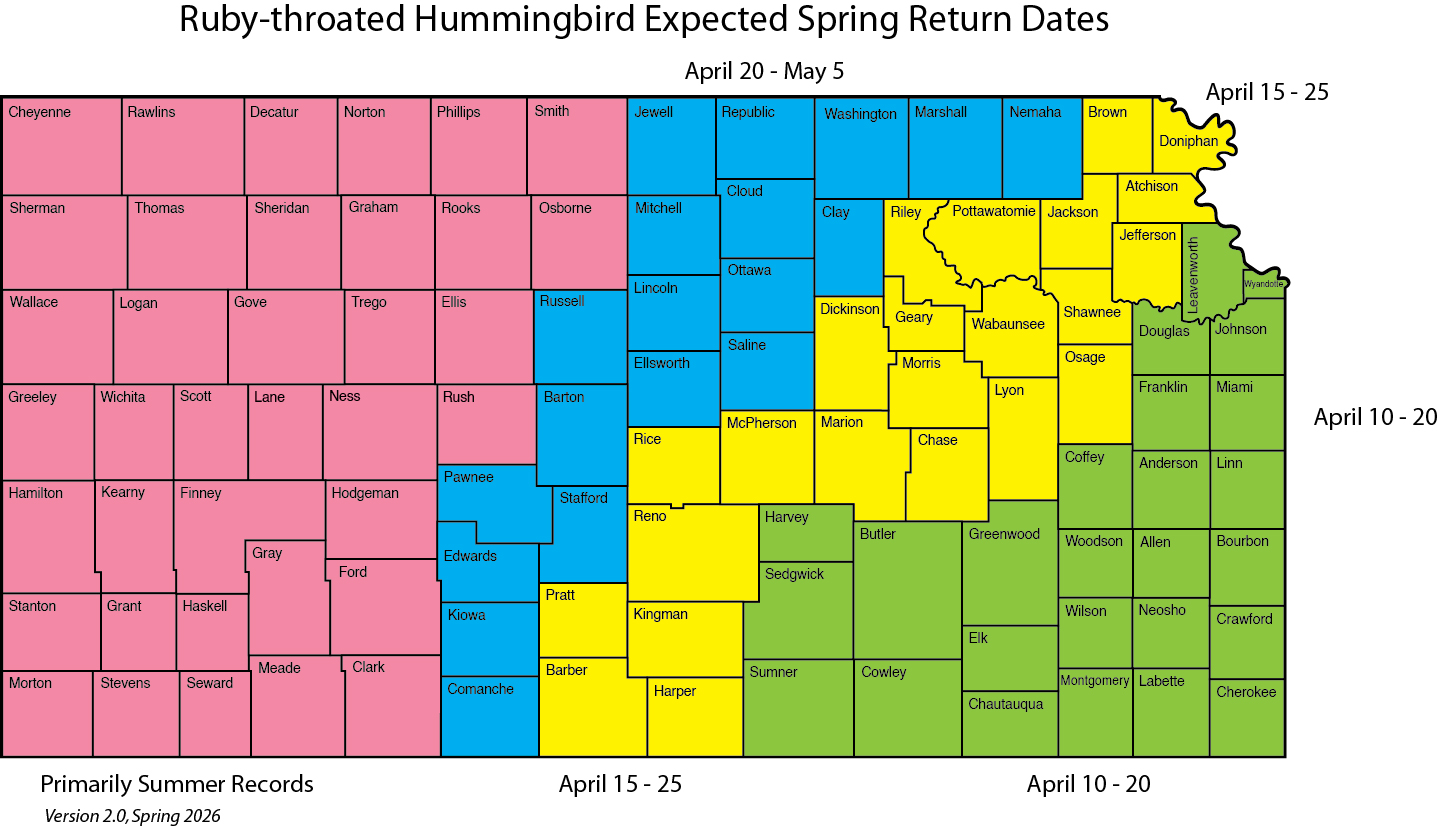
Expected Ruby-throated Hummingbird Spring
Return Dates for Kansas
Version 2.0, Spring 2026 - Chuck
Otte
Kansas is the western edge of Ruby-throated Hummingbird nesting area as well as their expected northbound migration range. Every year many homeowners/backyard hummingbird feeders ask when they should be putting their feeders out. In other words, when will the hummingbirds arrive?
Ruby-throated Hummingbirds winter in southern Mexico and much of Central America. Some also winter on the southern coasts of Florida but those birds do not migrate through Kansas. Northbound migration will take two paths. Some birds will follow the Gulf coast of Mexico into Texas and then spread out and move north. Others will launch off the Yucatan Peninsula of Mexico and fly non-stop across the Gulf to the Texas and Louisiana coast. From there they slowly spread north with eastern Kansas counties (and eastern states) noting their arrival slightly earlier. While they are more prone to move with southerly winds, timing becomes crucial so that they don't over run their food sources. A warm March in Kansas doesn't indicate an early return as there would often be little or no nectar or small flying insects.
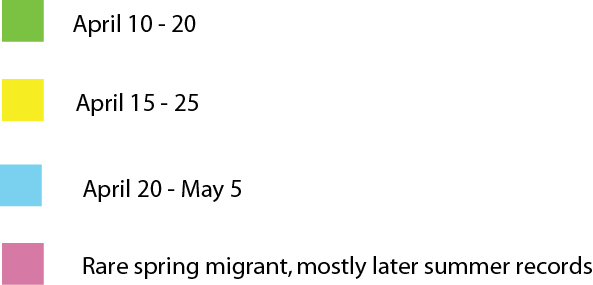
The map below is an attempt to indicate approximately when to put feeders out to attract early migrants (key below the map). Return dates will vary annually based on weather and food supplies. Migrants will continue to arrive and move through the state well into the end of May. Most of the hummingbirds that enter our state boundaries will move on north, as weather allows, to nest. During most of June and early July we will have nesting occurring in Kansas. In late July, southbound migration begins and lasts into early October (this is also when the less common western species will wander south through Kansas. Even if you have no hummingbirds during June (indicating that they are not nesting near your yard/feeders) be sure to have feeders cleaned up and filled by late July. A lot of time was spent analyzing Ruby-throated Hummingbird, mainly from eBird, in late winter 2026. First return records were evaluated from 2020 through 2025 and that information was used to refine, update and simplify the map for spring 2026. Return dates vary from year to year and the map below takes into account earliest return dates over the past six years along with average return dates in that same time frame. The map is intended to help those who put up hummingbird feeders, for Ruby-throated Hummingbirds, know about when to put them up. I would suggest putting one up on, or within a day or two, of the early dates shown for your county. Put minimal amount of nectar (4 parts water, 1 part pure white granulated sugar, no dye and no other additives) in the feeder until the hummingbirds show up and then adjust as intake requires. Please log your first arrival dates in eBird or send that date to me for future updates and revisions to the maps.
A great deal more information about Ruby-throated Hummingbirds (or any North American breeding species) can be found at the Cornell Laboratory of Ornithology's All About Birds website. Ruby-throated Hummingbird information can be found here. Daily tracking of where Ruby-throated Hummingbirds (or any bird species) have been seen can be viewed at eBird.org in the Explore section and then Species Maps. You may have to set up a free account with your email address before you can access some of information on eBird.
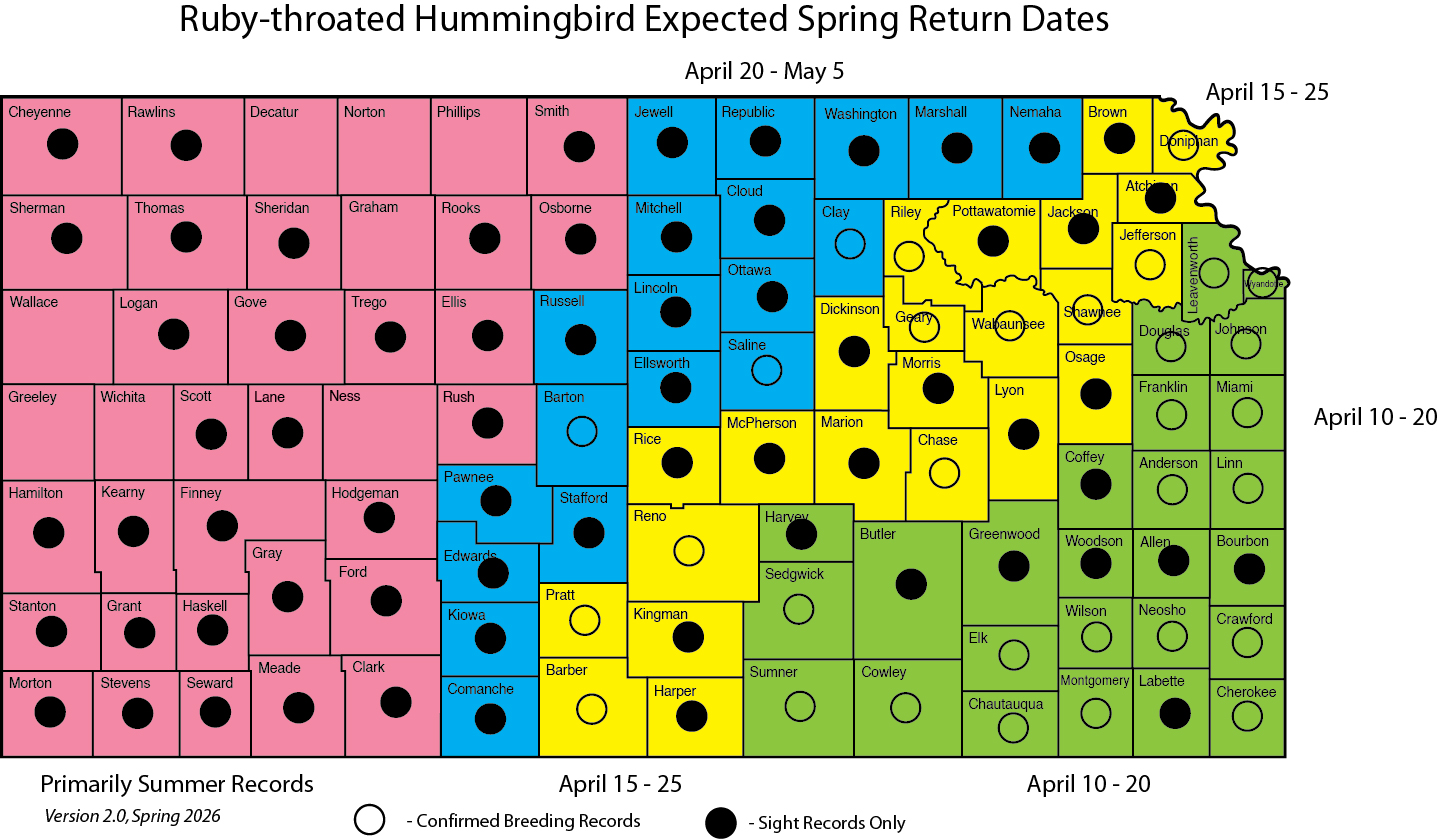
The following map overlays the above expected return date map with the county dot maps. Solid black circles indicate sight records. The open circles indicate confirmed breeding records. No dot in a county indicates that there is not a Ruby-throated Hummingbird record from that county. (County dot map updated as of November 1, 2025). If you have additions to this map (new breeding records or new sight records for counties without Ruby-throated Hummingbird records, please email Chuck Otte at cotte@twinvalley.net. These maps will be refined and updated annually in an attempt to make them more accurate. Your input can be very helpful. Details on what qualifies as a confirmed breeding records can be found here.
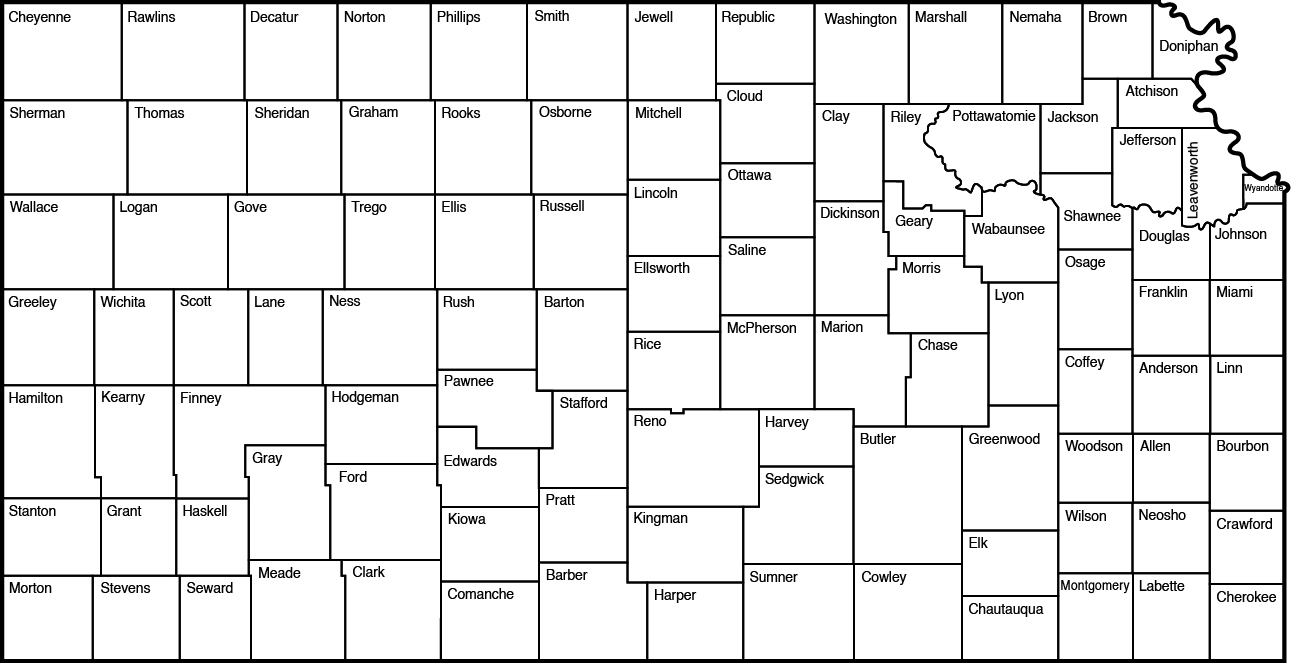
More information, maps and updates will be added here later this spring as migration winds down.
Below is the earliest return dates for 2026 as reported to eBird, Kansas Birding Facebook
page, KSBIRD-L, or directly to me.
If your county isn't represented, or you have an earlier date, please send me an email telling me the county
and the date you first saw a Ruby-throated Hummingbird this spring.
Updated February 25, 2026 by Chuck Otte